Working with data is no longer confined to specialists; almost every role now involves interpreting, using, or collaborating with data.
Organisations expect faster, evidence-based decisions, yet lack staff with the ability to work speedily with data. Taking messy information, interpreting, structuring it, cleaning it, identifying patterns and trends, creating reports, and communicating findings in a clear and usable manner. Organisations need people who can work effectively with data in their everyday roles.
Whether identifying workforce trends, improving forecasting accuracy, optimising campaign performance or meeting customer expectations, employees will perform better if they have the essential data skills.
HR Consultants, Management Accountants / Financial Analysts, Marketing Specialists, Product Analysts, and Customer Experience Specialists, will all accomplish more if they have strong analysis capabilities.
Many organisations still lack the capability to use their data successfully
Staff rely on reports they don’t fully understand
Conflicting numbers across departments
Slow decision-making due to data bottlenecks
Over-reliance on analysts or BI teams
Poor data understanding impacting on projects such as Artificial Intelligence (AI).
The ability to quickly, efficiently, and accurately translate the content of technical systems into meaningful information for customer servicing and business decision-making can transform organisational performance.
Organisations are not keeping up
Enabling people to think, decide and act using data, is a high-impact capability-building initiative that can be rolled out across you organisation to take a major step forward in:
Productivity
Data Quality
Decision-making
Business Impact.
The ability to analyse data should be viewed as a core organisational competency, required throughout the workforce.
Being able to spend less time interpreting data, and making faster, fact-based decisions, will increase self-service capability, reduce costs, and improve revenue opportunities.
Using high quality inputs to create reliable outputs, and identifying and rectifying issues early, will mitigate risks and reduce errors and rework.
When everyone can work and communicate well with data, teams will be able to collaborate better, share understanding, align on common metrics, and resolve conflicts more easily.
With high quality, well understood data, your organisation will be prepared for AI-driven automation. Analytics skills are foundational to AI readiness.
What Data Analytics capability can deliver
Thinking with data is a real skill, it is more than simply using technology. Tools such as Microsoft Excel, Power BI, SQL, Tableau are integral components in the Data Analyst’s toolkit but true capability lies beyond tool usage, knowing how to work with datasets in realistic business scenarios.
The real skill lies in truly understanding:
What the business is trying to achieve,
Which data to use,
Where to collect it,
How to validate it,
How to prepare it and address any issues,
How to break results into meaningful categories,
What you are looking for, when interpreting the data,
How to see correlations, compare performance over time,
How to identify and highlight risks, issues, opportunities etc,
How to link findings and recommendations,
How best to present the findings,
Where to focus business attention,
How to translate data into clear, compelling stories that prompt the right actions.
Empower all your employees with the capability to take messy data, clean and structure it, analyse and interpret it themselves, and then communicate their findings for action, without having to wait on another team to do this for them.
The Organisational Impact
Teach your teams to Improving capability will streamline operations, reduce hand-offs and wait-times, and enhance job satisfaction.
Give:
Executives the ability to reach strategic decisions faster,
Managers the ability to interpret operational insights more efficiently,
General Staff the ability to work confidently with data in their day-to-day roles.
Your specialist Data Analysts will continue to handle more complex, technically challenging analytical requirements, supporting initiatives such as AI, whilst the broader workforce can become self-sufficient in routine analytical tasks.
Does your organisation fully appreciate how important data capability is to success? Does it appreciate the need for all employees to have a minimum level of data-related competency?
Data is no longer a specialist skill; it is a core business capability.
Many organisations understand that data is the foundation on which their processes operate. However, translating this awareness into the realisation that everyone in the organisation needs the ability to directly and effectively create and utilise this foundation, is not as greatly appreciated.
Key considerations for your Data Foundation
When looking at the state of the data and its ability to support future initiatives, things to consider are:
Data Governance - have you implemented a sustainable governance function? Are Data Owners and Data Stewards fulfilling these roles? Are meaningful Data Policies in place? Do you have transparent, ethical usage of data? - Data Governance needs to be integrated into daily operations.
Data Quality - do you have standardised definitions and consistent use of terminology across the organisation? Is the quality of critical data continuously measured? Are root causes addressed, not just symptoms? - trusted data is essential.
Data Platforms - have you transitioned to cloud data platforms, consolidated data warehouses and lakes, improved integration, enabled real-time analytics? - AI is driving the need to be scalable.
Data Analytics - as analytics become embedded in daily operations and self-service BI expands, decision-making is shifting from technical teams to business users - Data Analytics must become part of everyday business activity.
Data Management - organisations are extending data capabilities and improving Data Management Maturity across the organisation, enabling better collaboration across business units when it comes to data -Data Management Maturity is a key enabler.
The traditional model – Data Teams and Data Specialists
Traditionally businesses have built their data capability through dedicated data specialists and data departments. Data Capturers, Business Intelligence/Data Warehouse teams, maybe a Records Management or a Data Quality / Data Governance project. These were the people responsible for the data, while the rest of the organisation got on with marketing, sales, or customer service etc.
As technology evolved, processes and decision-making have become increasingly dependent on the underlying data, and the number of data roles and data teams across the organisation has grown accordingly. Companies have introduced roles such as Chief Information Officers or Chief Data Officers, and they have expanded functions, with multiple teams for Data Governance, Metadata, Data Quality, BI & Data Warehousing, Data Engineering or Master Data Management.
Things are changing again
As organisations turn their attention to Artificial Intelligence (AI), executives have realised that despite this growth, certain challenges remain:
Analytics are not yet business-led
Quality remains inconsistent
Similar reports often produce conflicting results
Compliance and ethics continue to pose challenges for governance frameworks.
In spite of having these dedicated data teams in place, gaps remain.
Many businesses are lacking a solid data competency on which to build. To enable transformation readiness, the development of data-related skills development for all, is required.
While Data Professionals must continue to be equipped with the specialised expertise, they need to support the transition; organisations must also ensure that all employees achieve a baseline of data competency, to work effectively in the changing environment.
Today, everyone works with data, understanding it, interpreting information, generating insights, and creating reports. Data underpins virtually every business activity, making elementary data-skills essential for all. In addition to the obvious AI-specific skills to be developed, Data Literacy for the entire workforce should be addressed.
Your Data-Skills Development Strategy needs to include plans to educate those who traditionally, have not been deeply involved with data. This is where significant, often untapped opportunity exists.
The current emphasis is on technology, and its deployment usually sits centre stage. However, technology alone cannot create value. Institutions need to focus on the deployment of the technology, and the supporting elements of people and process.
For successful transformation, all aspects of change should receive attention. Many organisations have invested heavily in data platforms and tools, but the gap lies in people’s ability to use them effectively.
Organisations must develop new competencies, to maximise their use of the emerging technology.
All staff need data skills - build a Data-Literate Culture
Whether communicating their findings, or interpreting information received, data proficiency significantly influences how well people can perform.
An elementary set of competencies that enables the entire workforce to work effectively with data - understanding it, using it efficiently and communicating clearly - can positively or negatively affect your business performance.
Everyone in the organisation now deals with data, not just the data specialists. You need a data-literate workforce, where individuals:
understand data,
use it effectively,
recognise its potential,
value its impact.
Ensure that your data professionals have the advanced skills required for their specific roles, while also ensuring that all their colleagues are data-literate, and can work with real-world data, interpret it, analyse it, and translate it into clear actions, as well as knowing how to contribute positively to the quality of the organisations’ information.
You cannot become AI-enabled without first becoming data-literate. Every employee must be able interpret the data they are using, produce meaningful outputs derived from the data, and contribute to its quality. They need to do more with data now than they used to.
If all employees work competently with data, they will be able to determine:
whether the data is accurate and trustworthy
if you have the required metadata and lineage
whether the governance practices are adequate
if you will be able to scale safely
whether the data is fit for AI use.
Organisations should focus on strengthening Data Culture, Data Centricity, and Data Management Maturity. By improving maturity, you will unlock greater value to benefit all your initiatives.
If the organisation’s overall Data Competency and Data Management Maturity are strong, you will be significantly better positioned to succeed with AI initiatives.
Customer Centricity
Those of us who were around in the 90’s and early 2000’s will remember the focus that most organisations started to place on Customer Centricity. Suddenly everyone in the business had customers, not just the sales personnel who dealt with the buying public.
The realisation that every person in the organisation was producing an output, which someone else used and needed, meant that each of us had a customer to service; someone whose requirements we needed to understand, someone whose satisfaction was important, someone whose feedback mattered.
Organisations moved from being product centric, focusing only what they could make and sell, to also focusing on the relationships they had with the people to whom they wanted to sell, alongside efficiently building products.
There were new initiatives to understand the customers:
Who are they?
Where are they?
What are they buying?
When are they buying?
How do we service them better?
And importantly, why are they buying – what are they trying to achieve, what is working for them, what is not, which touchpoints are preferred, etc?
The influence of the internet cemented the need for all businesses to focus on Customer Centricity. Customers could now get more information relatively easily:
they could compare prices
gain insights from other customers by checking reviews and forums
share information if they had bad experiences.
Companies could also collect more information about their customers. CRM Systems, Loyalty Programs, Segmentation and Personalisation were all important.
By 2010 Customer Centricity was mainstream. Social-media had become a daily activity for most people, who now had smartphones, and were starting to use subscription models to obtain products and services.
Retention of customers to provide lifetime value became a key objective.
Managing the end-to-end journey with relevant metrics, designing with the customer needs in mind, investing in the data to provide the feedback required, to keep improving, and reacting immediately when customers needed assistance, as well as measuring how well this is being done. We need data to understand all of these things, to determine how to create better value.
Having the information that enables you to understand the customer’s expectations, and then seeing these expectations as central to our strategies, marketing, process design etc. is key to making things easier for the customers in your target markets.
These developments, whilst strengthening Customer Centricity aims, triggered the beginning of what is going to be the next core focus - the information needed to support the development of effective customer-centric solutions, drove the need for this new discipline, Data Analytics.
The data is there, it exists and when it is accurate and reliable and correctly applied, it can be used at relatively low cost to create enormous value. The question of value is on everyone’s lips:
Are we creating true value?
Have we got the balance between customer delight and costs?
Do the customers find it easy and simple to deal with us?
Do our customers truly believe and trust in us?
Are we meeting the legislative and ethical requirements in a way that is improving how we are perceived by the customers?
Are we measuring all the outcomes we need to monitor?
Are we getting the right results?
Do customers feel connected to us?
To answer these questions with confidence, business managers rely on data, reports, dashboards, messages from their staff, and correspondence directly from the customers. All this information needs to be gathered, collated, cleaned and filtered where incorrect or inappropriate, analysed and understood, then turned into well designed objects of communication that all who need to use them can easily understand.
In the Information / Digital Age, with the era of Artificial Intelligence upon us, the shift to this focus is taking hold in the minds of all business people – this is Data Centricity.
Data Centricity
Business leaders have realised that, just as retaining customers for their lifetime is a worthwhile goal, creating and retaining quality data, which can be used for the lifetime of the business & the customer, is a goal worth achieving; one that will provide significant benefit, which could be a differentiator in the marketplace.
Every one of us, every day, is now working with data, to produce information for our customers to use. Almost every person in the organisation is now required to regularly provide information products as part of their job. These outputs are then used by our direct customers to make decisions, whether that is internally in the organisation or externally as the end user.
Now we need to service all our customers with a data-driven approach:
to understand their requirements,
provide the insight that they need,
in a manner that works well for them,
and enables them to make the correct decisions based on this input.
The underpinning role of data in everything we do, requires that all of us acquire a base level of data skills.
Basic data related skills that enable one to:
understand what information our customer needs,
know what data needs to be used to provide these insights,
ask whether there are any legal or ethical considerations that need to be considered,
think about how to design for this, to be done cost-effectively and efficiently,
create processes and systems across the organisation, not in silos, to gather and prepare this information,
question what do we do automatically, and what do we need humans to do?
Creating customer and business value through data and information products, needs to be your top priority. How you treat your data will influence your competitive advantage. Everything you did for Product Centricity and then Customer Centricity, needs to be done with data at the centre.
One of the critical success factors is trust.
Do the internal customers trust the data they are getting?
Do the end-customers trust us with their data?
Are we creating data assets, that can be used over and over again?
Data Centricity is not a technology issue; it is a leadership discipline. Questions to address:
Are we eroding the power of our data or treating it as a strategic asset?
Are we designing around data or addressing it as an afterthought?
Do we really treat data as an asset - is it owned, do we handle it with the same care, as we would one of our other assets?
Do we focus on value creation, to guide how we get and maintain information, as opposed to amassing volumes of data.
If you think about what is required, you will realise that the organisations who have mastered Customer Centricity, have also addressed Data Centricity. They are truly data-driven, in the way in which they design and operate their business, they manage data so that the organisation can act to meet the customer’s needs.
The data foundation supports the business objectives, one of which is customer service. The organisations that win in the next decade will not be the ones with the most data, the most dashboards, or the most advanced tools. They will be the ones that focus on Data Centricity:
Treating data as a shared asset
Designing data around value and outcomes
Governing data to earn trust
And placing humans, not systems, at the centre of decision-making.
Customer Centricity or Data Centricity? – the answer is both - integrating data-driven analytics into customer-centric business models and processes will get you the results you need.
Data Centricity focuses on how decisions are enabled, scaled, and trusted, while Customer Centricity focuses on who we serve.
Yikes! What can I say about 2025 except that it’s been life changing.
When you get to my age, sometimes you feel like there’s not much more to learn but guess what; that’s just not true. I am blessed that I am still learning.
Being by default a teacher, I have always been interested in the process of learning and trying to help people improve their knowledge and skills, their understanding and interest.
I am keen to hear how people are doing, where they are succeeding and where they face challenges, and to share what is working for me.
So, how has this year been for you, has it been a good one, or has it been a challenging year? For me it has been quite exciting. I travelled to Norway and Iceland and would you believe it, Greenland, and gained a different perspective of the world I live in. I saw real icebergs and they reminded me of the complexity of data. Data is something in which I have always had in interest.
Standing there in the Arctic, watching these vast ice formations, I realised that ignoring what lies beneath the surface is exactly what causes us problems. You can't navigate safely by only focusing on what's above the water. You need to grasp the full picture: the good, the bad, and the hidden, to truly master your environment.
Coincidentally, this year I also gained a different perspective at work. I have been involved in new tasks that use data with which I am not very comfortable. It has made me practice what I preach: to go back to basics, following the same advice I have been sharing with others, to ensure that this data and its environment are managed properly.
How has 2025 been for you?
As we approach the end of the year, in addition to how well has your 2025 gone, let me ask you a few data specific questions:
Have you tackled specific data initiatives?
Have you established useful data forums?
Have you, or your organisation, acquired new data skills?
Overall, are you satisfied with your data? Does your data meet your needs? Is it available when & how you need it? Is it of good quality? Can it support your future business requirements?
Most of the people I have asked have not been able to answer positively. Considering this, I looked back on the year to see what we had tried to teach people.
Looking back on 2025
We began the year focusing on returning to basics, then moved on to enhancing Data Quality and decreasing Data Debt – all essential priorities.
Next, we focused on how to develop Data Stewards and Data Owners, and how to position these roles for the future.
We discussed how the role is likely to evolve, or not, as we adopt Artificial Intelligence. We ended the year exploring ways to get more from training, proposing a revised approach that delivers more, particularly in challenging times.
Looking back to go forward
Overall, we covered quite a lot in what has been an interesting year. I certainly found ‘back to basics’ to be an excellent reminder that what seems simple and obvious holds great value.
Often, we overlook the basic truths of data and the fundamental things we need to do.
Getting back to basics - understanding each other
My role as a trainer mainly involves understanding. Understanding what people want to know versus what they need to know and balancing the two, so I meet expectations. Therefore, I spend time ensuring my language is suitable for the audience and continually evaluate their understanding.
Does your organisation speak a common language when dealing with data?
How well do you all understand the fundamentals, terms, and concepts?
How effectively do people communicate? Do they always understand each other?
Let's flip these questions:
How frequently do you misunderstand each other when working with data?
How frequently do communication issues influence results?
Is Data Literacy a competency that your organisation has mastered?
Data Literacy is so fundamental and foundational, but often overlooked.
It greatly impacts an organisation’s capacity to operate effectively, innovate, and make well-informed decisions.
Do you now understand the scale of your data debt problem?
Have you taken any steps to address the data debt in your organisation?
Much like an iceberg, where only 10% is visible above the water, most organisations only see the surface of their data—the reports, dashboards, and immediate outputs. But beneath the surface lies 90% of what truly matters: data quality issues, lineage problems, hidden dependencies, technical debt, and core data management practices that either support or undermine your entire operation.
I recently faced a problem with my laptop and couldn't believe the ‘data debt’ I had built up over just two years. Get your own house in order!
Building the Data Triangle
We examined the vital importance of Data Stewards and the need for Data Owners and Data Stewards to truly collaborate, rather than operate separately. The Data Triangle remains incomplete without the cooperation connecting these two essential roles.
Are your Data Owners and Data Stewards collaborating effectively, or working separately?
Have you established the necessary bridges to make this partnership succeed?
The Role of Data Stewardship in the world of AI
The marvellous ‘Data Diva’ Lisel Engelbrecht joined me earlier this year for a webinarto share her views on the evolving role of Data Stewards in the age of Artificial Intelligence. It reminded me that we must embrace change, why be threatened by change? Surely, we have always adapted to it.
This session motivated me to really understand AI and its potential in data environments. WOW! What can I say? I experimented, explored, and made friends with many AI tools. I created templates to remind me to include context, questions, and audience details. I improved my approach and learned to work alongside AI.
Wow again! Working alone at home, I suddenly felt as if I had a colleague in the room with me. 'We' could explore, debate, agree and disagree. I'd propose an approach, AI would challenge it or suggest refinements, and together we'd arrive at something better than either of us could have created alone. It's an example of collaboration in its truest sense, building on one another’s strengths.
Are you seeing AI as a threat to your role, or as a tool to improve it?
What would change in your Data Management Approach if you had a tireless assistant who was always available?
The Power of Education
When you train a team, they experience together and leave with a shared understanding of what to apply on the job. You gain so much more than just knowledge. This simple yet highly effective training method makes a real difference.
I am currently training a team, and what has been especially rewarding this time is that the delegates now view their data from varied perspectives – not just their own. They now recognise how their colleagues rely on and utilise the data they generate. A true AHA moment for the team😊
Are you still sending individuals off to courses, or have you started training as a team?
When you train together, you establish alignment, develop a shared language, and ensure everyone starts from the same baseline. Additionally, you make the problem and solution everyone's responsibility. Training as a team isn't just more cost-effective; it also fosters a collaborative culture and the shared accountability you need.
Wrapping up this year
Looking back, I find it interesting to see how many things we can do that are simple.
When we started with 'Back to Basics' earlier this year, I wasn’t considering myself; I didn't realise it would apply to me too. Once I did, everything changed.
As this year draws to a close, I am pleased with the progress I have made. I faced the challenges directly; yes, I struggled, but I am now ready to enter the new year with new skills and a fresh mindset. Just as those Greenland icebergs reminded me to look beneath the surface, 2026 will focus on going deeper but not more complicated - more fundamental.
Let's make next year the one where 'back to basics' finally becomes a habit.
As Artificial Intelligence (AI) and Machine Learning (ML) reshape how we manage data, it’s tempting to think everything about Data Quality has changed.
Think Differently
In this context, thinking differently does not mean replacing people with technology, thinking differently means understanding it’s about partnership.
Tools bring speed, scale, and consistency.
People bring context, judgement, and accountability.
Organisations that get this right invest in both: the tools and the people who use them.
Think about what’s changed?
The repetitive work is automated: Validation, duplicate identification, and routine fixes can now run automatically, freeing Data Stewards to focus on value added tasks such as interpretation and improvement.
We can see Data Quality Issues on a large scale: AI can quickly analyse millions of records, uncovering anomalies, duplicates, and systemic errors that once took months to detect.
We can predict where problems will occur: Machine Learning doesn’t just find existing issues — it forecasts new ones, shifting from reacting to anticipating.
Monitoring is continuous: Quarterly Data Quality reports are giving way to real-time monitoring, allowing issues to be addressed as they happen.
Think about what hasn’t changed?
The process remains the same: We still need to assess, gather requirements, measure, correct, and prevent.
Quality still needs defining: AI can measure and compare, but only people can decide what “good enough” means. Completeness, accuracy, and timeliness all depend on business requirements.
Trust depends on transparency: If users can’t understand why data has been flagged as poor, they won’t trust the results. Clarity and transparemcy are now critical.
Governance matters more than ever: Without clear accountability and responsibility, automation can surface issues faster than we can respond.
Think Differently – what this means now
While the technology has transformed how we work with data, the fundamentals remain the same.
AI will not solve the Data Quality problem; it will raise the bar.
We can now detect, predict, and monitor like never before. However, success will still depend on process, governance and people who understand what quality means to the organisation.
Understand your organisation’s requirements properly to be sure what it is that needs attention. Then let the technology work for you and embrace the change.
Remember to deal with the data in an ethical way.
This World Quality Week, Think Differently means using modern tools to strengthen the fundamentals; people, process, and governance, so we can deliver better, faster, and smarter.
Training courses and formal education are essential steps in learning and development.
Thinking differently about how you train can unlock far greater value for your team and your organisation.
Instead of sending individuals to courses, train as a team.
Shared learning will realise many extra returns, which are often overlooked or forgotten. Training as a group fosters alignment, enhances performance, and cultivates a culture of collaboration and accountability.
Investing in training a team, places the group in a position to flourish as a collective, from a shared experience, which all can then apply on the job.
Alignment:
Developing your team’s skills together ensures everyone learns with the same purpose and direction.
Choose a subject aligned to your business objectives and identify opportunities to develop your entire team.
Train the whole group. This will allow the new competencies to become truly integrated into the team’s processes, operations, and culture.
Performance:
Training as a team establishes a consistent foundation, creates a common language, and ensures everyone works off the same baseline.
When everyone understands what is required, performance improves, communication flows, and teamwork thrives.
From this point of reference, the united team can embed the new found knowledge and skills in operations.
Ambitious goals and high standards of performance can be set, as the whole team understands what is required.
Team culture can be fostered around the shared experiences coming from this initiative.
Continuous improvement can become a reality, as the team works together towards common objectives, having decided as a unit what it is that they are aiming to achieve, and what success looks like to the collective.
Consider focus areas such, data-driven insights, information quality, informed decision-making, and empowered teams, because these will provide significant benefit to your business.
People:
By including the entire team in the same training, you will ensure that the problem and the solution are everyone’s responsibility.
When each person knows what is expected and how they should perform, everyone is enabled to do what is required.
Including all team members across all functions of the unit, will build an inclusive culture, allowing all to take ownership of the actions required.
A shared learning experience will enable further teamwork and foster collaboration.
Inclusivity encourages collaboration and ownership, strengthening team spirit and enragement.
Create lasting value
Training delivered to a private group, produces results that extend beyond the classroom:
Consistent skills development: The entire team develops a common understanding and skill set, promoting consistent practices across the organisation
Relevant examples: Case studies, exercises, and discussions can be drawn directly from real situations within your business
Open discussion: Participants can speak honestly about challenges and issues, knowing everyone is from their organisation. Real-world problems can be solved during the training
Collaborative learning: Sharing ideas in a relaxed environment encourages creativity and trust among team members, which in turn improves co-operation and productivity
Team building: Completing activities together builds cohesion, which strengthens relationships, and fosters better teamwork
Improved implementation: When the whole team learns together, new knowledge is more likely to be applied on the job, compared to when one person attends training and returns to an unchanged environment
Immediate application: Workshops conducted during private team training can generate tangible outputs and create actionable work products, which can be immediately implemented back at the office, providing additional benefits from the time spent learning
Cost efficiency: Group training results in reduced costs while increasing overall benefit
Follow-ups: After the training, the group can continue to gather, reflect on implementation. The team should attend post-training follow-up workshops together, to discuss how application is working etc. and continue the learning journey.
This approach transforms training into a powerful experience of growth and connection, allowing participants to grow as a team, and jointly execute.
Training as a unit, enhances not only individual knowledge and skills, but elevates the capability and cohesion of the entire group.
Teams don’t just gain skills – they return motivated, aligned, and eager to apply what they have learnt.
A communal goal for excellence, can create an inclusive quality culture for your team. A culture where managing risks, improving performance, identifying opportunities and innovation become embedded in the way the team operates.
Think differently about training means seeing it as an opportunity for more than learning.
Provide your team with a greater experience, one that includes learning, but also includes quality time to bond with colleagues but not in an artificial way, rather in a manner where a business problem or opportunity is the focus of their collaborative attention,
Let them return to work energised and excited to see the results of their applied knowledge.
Invest in team excellence, quality culture, and shared success. Take your team to a whole new level of co-operation, quality output, and performance excellence, with everyone playing an active part, delivering lasting results.
In today’s data-driven world, organisations increasingly depend on the quality, accessibility, and reliability of their data to make sound business decisions. Behind every successful data initiative stands a committed Data Steward — a professional who ensures that data is properly managed, trusted, and used responsibly. While many individuals now carry the title, not all fully grasp the breadth of their responsibilities or unlock the full potential of their role.
Those who do embrace it make an undeniable impact. Exceptional Data Stewards don’t just maintain data assets; they elevate data to a strategic organisational resource. They enable better decision-making, ensure compliance with data governance principles, and champion a culture of data quality across the enterprise.
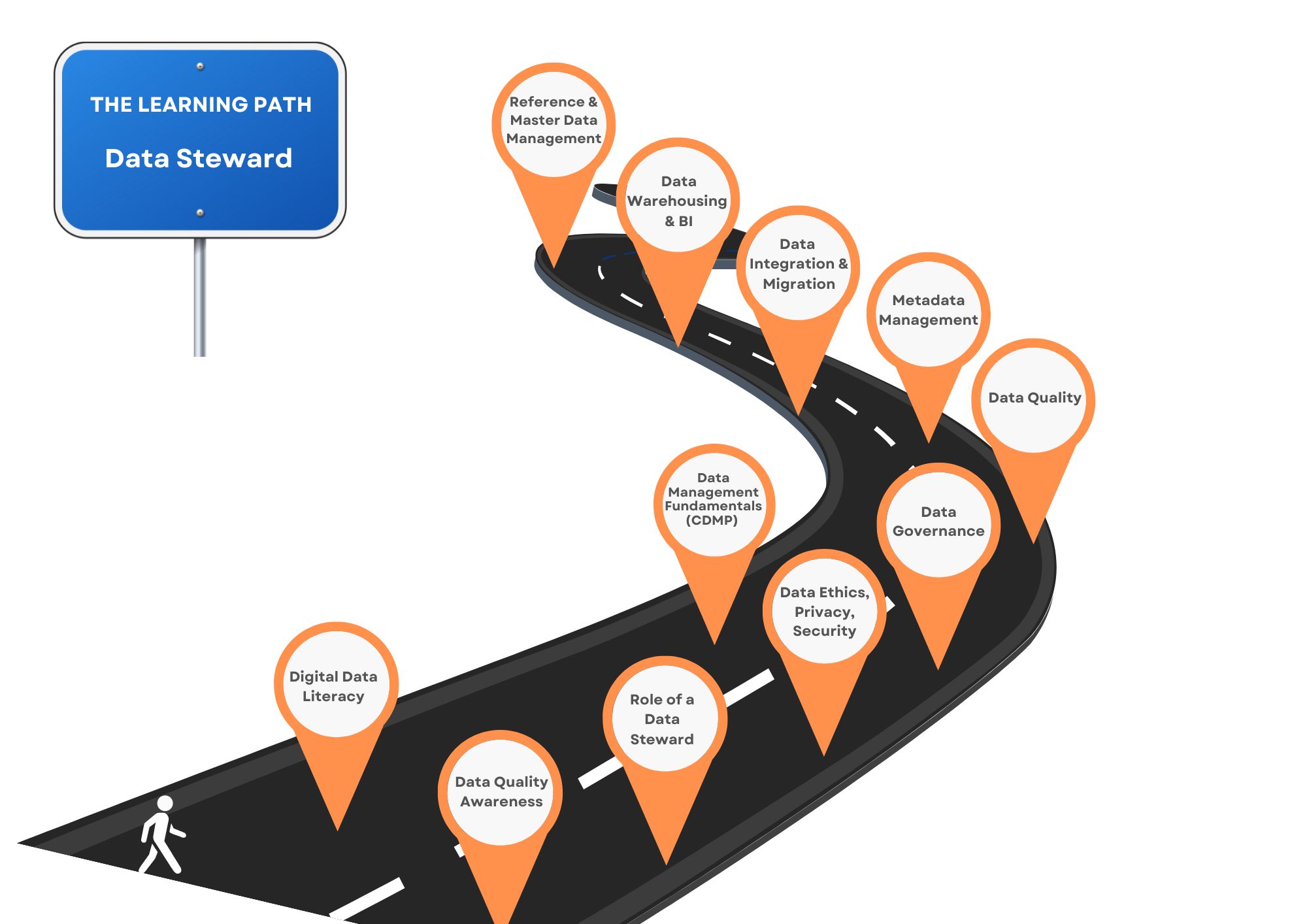
A well-defined Learning Path is essential for developing the competencies and mindset required to excel in this role. Structured learning ensures that Data Stewards build their skills in a logical sequence, progressing from foundational knowledge to advanced, specialised expertise. The following path outlines key stages to help you grow from capable to exceptional.
1. Begin with Foundational Data Literacy and Data Quality Awareness
Before mastering the technical aspects of data management, it’s vital to understand the language of data. Data Literacy is the ability to read, interpret, and communicate data meaningfully. It equips you to engage confidently with stakeholders, from executives to analysts, and to advocate for data-driven thinking across the organisation.
Equally important is awareness of Data Quality — understanding the principles of accuracy, completeness, consistency, timeliness, and validity. Poor-quality data erodes trust, leads to flawed decisions, and wastes valuable resources. A Data Steward with a strong grounding in Data Quality can not only identify and correct issues but can also educate others about the importance of maintaining high-quality data at every stage of the data lifecycle.
Start your learning journey by exploring introductory courses, such as data literacy and foundation. This will provide you with the conceptual grounding to help you explain to others why data matters.with the conceptual grounding to help you explain to others why data matters.
2. Enrol in a Comprehensive Data Steward Training Course
Once you have a solid foundation, the next step is formal training specifically designed for Data Stewards. A comprehensive Data Stewardship course will help you understand how your role fits into the broader Data Management ecosystem.
Look for training that covers:
Roles and Responsibilities: What you are accountable for as a Data Steward, and how your work intersects with roles like Data Owners, Data Governance, and other Data Professionals
Practical Tools and Techniques: Methods for cataloguing data assets, defining metadata standards, managing data issues, and improving data quality etc.
Business Alignment: How to ensure that your stewardship activities support business goals, compliance requirements, and ethical data usage.
An effective course will blend conceptual learning with real-world application, such as case studies, hands-on exercises, and exposure to Data Management tools. This experience helps you translate knowledge into day-to-day effectiveness and will position you to fill the critical role of Data Steward for your organisation.
3. Build Core Competencies across Data Management Disciplines
To be effective, Data Stewards need to master several core competencies. These include:
Data Governance: Understanding the policies, standards, and control processes that ensure data is properly managed and aligned with organisational objectives
Metadata Management: Knowing how to define, capture, and use metadata — the “data about data” that provides context, meaning, and traceability
Data Quality Management: Establishing and maintaining processes for profiling, monitoring, and improving data quality across systems
Privacy and Data Ethics: Ensuring compliance with data protection laws (such as POPIA or GDPR) and promoting ethical use of data.
Building competency in these areas transforms you from a data caretaker into a data advocate — someone who understands both the technical and human sides of managing data responsibly.
4. Focus on Specialist Areas aligned to your Organisation’s Priorities
As your confidence grows, consider your daily activities and business objectives and identify where further training will add the most value. Take time to study frameworks like the DAMA-DMBOK (Data Management Body of Knowledge), which provides a comprehensive view of all data disciplines.
Reflect on the following:
Are you involved in a Data Migration or Integration project where data accuracy and consistency are critical?
Do you contribute to Business Intelligence or Analytics initiatives where data availability and interpretation drive insights?
Is your organisation implementing a Master Data Management (MDM) system?
Each of these areas demands specialised Data Management knowledge. Exceptional Data Stewards continuously align their learning with their organisation’s goals and data initiatives.
Seek out opportunities to gain hands-on experience, such as participating in data governance committees, conducting data quality assessments, or contributing to metadata documentation. The more you engage with real data challenges, the deeper your expertise becomes.
Remember, the most effective Data Stewards are not confined to a single area — they are versatile contributors who understand how data flows through the organisation and how each system or process impacts overall data integrity.
5. Consider Professional Certification through the DAMA CDMP Program
Once you’ve established your specialist skills, consider pursuing formal recognition through the DAMA Certified Data Management Professional (CDMP) program. The CDMP certification, recognised globally, validates your knowledge across the full range of Data Management disciplines defined by DAMA International.
The Data Management Fundamentals exam is an excellent starting point and can be taken at any stage of your learning journey. Achieving CDMP certification in both fundamentals and specialist disciplines will demonstrate your commitment to professional excellence and your knowledge of data management best practices, enhancing your credibility within your organisation and across the broader data community.
6. Cultivate Continuous Learning and Collaboration
The data landscape evolves rapidly — with new technologies, regulations, and practices emerging constantly. Exceptional Data Stewards stay relevant by engaging in continuous learning.
Join professional communities, attend webinars or conferences, and follow thought leaders in the field. Participate in internal data governance forums to exchange insights with colleagues. Deep your understanding, build confidence, and connect to a global network of peers and mentors.
Collaboration is another hallmark of success. Data Stewardship doesn’t operate in isolation; it thrives on partnership with IT, business units, and compliance teams. By building relationships and fostering open communication, you can help bridge gaps between technical experts and business decision-makers, ensuring everyone is aligned around shared data goals.
7. Embody the Mindset of a Data Champion
Ultimately, becoming an exceptional Data Steward is not just about mastering processes — it’s about adopting a leadership mindset.
Exceptional stewards view data as an asset to be nurtured, protected, and leveraged. They are change agents who champion data culture and help others see the value of working with trusted, well-managed data. They lead by example, demonstrating integrity, and accountability for the data quality.
Strive to go beyond compliance. Encourage innovation, support data literacy initiatives within your organisation, and promote how data can create value for customers, employees, and the whole business.
Conclusion
The journey to becoming an outstanding Data Steward is one of continuous growth and meaningful impact. By following a structured learning path — from foundational literacy to advanced certification — you not only strengthen your own career but also contribute significantly to your organisation’s success.
Your organisation’s data, and indeed its future, depend on people like you: individuals who take stewardship seriously, who see data not just as information but as a strategic asset, and who are committed to upholding its quality, integrity, and ethical use.
Good luck on your journey to becoming an exceptional Data Steward!
A message to All Managers especially those in Learning and Development positions:
Why your organisation's success depends on everyone speaking the same data language
What does every job in your organisation have in common? Yes, of course - it's data!
From HR records and employee surveys to finance and operational reports, from customer sales and performance metrics to risk analysis and compliance reporting, data underpins everything we do.
However, the truth is that while we've become increasingly dependent on data to drive decisions, most of our workforce lacks the fundamental skills to work efficiently with it or communicate effectively about it.
The problem isn't that people aren't capable enough – it is simply that no one has taught them the data language and the basics they need to work effectively with data.
This is fixable through appropriate and effective education.
What People Need to Know
The fundamentals are straightforward but rarely taught:
Knowing what data means and how it's used - not becoming a statistician, but understanding its context and purpose for the organisation
Understanding upstream and downstream effects - knowing who produces and uses data, and how it impacts the business as it flows through the systems
Appreciating quality data – being able to recognise complete, accurate, and timely information whilst identifying potential issues before they become problems.
If people understood these fundamentals, they would perform their jobs more effectively, make fewer errors, become more productive, face fewer challenges, and make a greater impact on the organisation.
When you build a foundation of Data Literacy, you achieve results on three levels:
Individual transformation - Employees understand the impact of their work, become more confident working with data, and begin to drive data-driven operations
Cultural transformation - Data Quality becomes everyone's responsibility rather than just IT's problem, ensuring a collaborative approach
Organisational transformation - Decision-making becomes evidence-based, it is easier to embed compliance into operations, and innovation initiatives can gain the necessary traction.
The Hidden Cost of Data Illiteracy
Appreciating the importance of Data Literacy is a good start, but knowing how to translate this awareness into concrete action that transforms your organisation's data capabilities is the key. Understanding the effects of the problem will help you formulate an effective action plan that addresses your specific needs.
Data Debt is the hidden burden created when people fail to manage data effectively. Data Debt manifests as missing data, duplicate records, incomplete datasets, and inaccurate information flowing through your systems.
It arises when shortcuts are taken to quickly access or create data, leading to poor quality and inconsistencies, which in turn result in further unreliable information, eroding trust in analytics, hindering productivity, and stifling innovation.
Poor data quality and incomplete information require manual data management, which increases costs and decreases efficiency. Data Debt significantly impacts generative AI initiatives, making Data Literacy both a current necessity & future competitive requirement.
When your people lack a sufficient understanding of the data they are working with, they create more problems than they solve. When they don't speak the same data language:
Terms are understood inconsistently
Outcomes are unpredictable
Decision-Making is impacted
Compliance becomes a nightmare
Innovation stalls due to issues with data fundamentals.
What’s Next?
The question isn't whether your organisation needs better Data Literacy, but how quickly you can implement training that makes a real difference. The time for action is now. Your data - and your organisation's future success - depends on it.
If you are a Learning & Development Manager, an HR Manager, or in a Data Management role, you should assess the level of Data Literacy in your organisation and decide where change is needed. Organisations investing in Data Literacy today will succeed tomorrow.
With data underpinning everything your organisation does, you cannot afford not to invest in Data Literacy Training.
Making the Business Case
If you need to motivate for funding for the training, ensure that the decision-makers understand the consequences of the current situation. Explain the problem and effects when people across your organisation are not data literate.
When presenting to senior leadership, focus on these arguments:
Risk mitigation - data breaches, compliance failures, and poor decision-making result from inadequate Data Literacy. Training acts as insurance against costly mistakes.
Efficiency gains occur when people understand data properly; they spend less time correcting errors, searching for information, and resolving conflicts.
Innovation enablement - AI and digital transformation initiatives rely on data and on people who understand data quality, data governance, and ethical handling.
Competitive advantage - organisations with high Data Literacy make better and quicker decisions than their competitors.
If you are facing budget constraints, remember that by doing more with your current team and existing data, you can enhance knowledge and skills, improve existing business processes and support systems, and enable other initiatives to benefit from better data.
At a fraction of the cost of major transformation initiatives, you can optimise resources and create new opportunities through training. Education is especially valuable when budgets are tight. Train your staff, and your data improves. Improve your data, and your business improves. When you do, you'll realise that enhancing Data Literacy isn't just about teaching technical skills, it's about unlocking potential already within your workforce.
I've been in this field for decades and have seen countless data practitioners struggle to advance their careers. Despite having the experience and doing good work, they often don’t receive the recognition they deserve or are not taken seriously when they raise issues.
Data practitioners are expected to cover a wide range of topics; they oversee data quality, ensure compliance with regulatory requirements, and must be knowledgeable about privacy and security needs, operational systems, cloud platforms, complex data architectures, data lakes, data meshes, master data hubs, data integration, data quality management, metadata, data analytics, and constantly evolving requirements.
However, one aspect is often missing: credibility.
A CDMP qualification can help.
CDMP, the Certified Data Management Professional qualification, is the industry standard that distinguishes genuine Data Management Professionals from those who simply handle data. It is based on the DAMA DMBoK Framework and thoroughly covers all facets of Data Management.
What Can You Achieve with CDMP?
A CDMP qualification alters the landscape. Progress your career with the kind of credibility that only results from a formal qualification and acknowledgement of your expertise.
Experience alone is insufficient. Colleagues with credentials will receive more opportunities and be promoted ahead of you. If you believe your experience speaks for itself, you are overlooking how the industry has changed. The cost of standing still isn't neutral - it's falling behind.
Everyone in the organisation should aim to deepen their understanding of data. However, CDMP is tailored for dedicated Data Management Professionals who recognise that data management is a discipline, not merely a job function, and wish to showcase in-depth knowledge across the entire discipline.
With a CDMP certification:
You can advance your career faster and command higher salaries
You will access better opportunities and take on more strategic responsibilities.
You are more valuable to your organisation and the broader industry.
With CDMP credentials, when you discuss data governance, quality, or architecture, people pay more attention because you are showcasing knowledge validated by industry standards.
How to approach CDMP certification
Invest in Quality Preparation
Don't attempt to wing it. The DAMA DMBOK V2 spans nearly 600 pages filled with data-related facts — navigating this alone can be overwhelming for most people.
Seek training programmes that give a clear overview of the book, making the material easier to understand and apply. Ensure they cover all knowledge areas while helping you recognise the connections between them. The best programmes are run by experienced CDMP-certified professionals who are enthusiastic about Data Management.
What's more important though is that pursuing CDMP isn't just about passing the exam, it's about genuinely broadening your knowledge.
Plan for comprehensive learning, not just exam success
The CDMP exam is challenging, but passing it is only the start. The real benefit comes from truly mastering the DMBOK framework and applying it effectively in your work.
Many professionals concentrate solely on exam preparation, but the most successful see the certification as the beginning of a deeper learning journey. Plan your approach to achieve true understanding that will benefit you throughout your career, not just help you pass a test.
Knowledge acquired through DMBOK study can revolutionise your approach to challenges.
Concentrate on developing the knowledge and skills that enhance your effectiveness in any Data Management environment.
Think beyond the Exam
The exam assesses both conceptual understanding and practical application, but your aim should be much wider. Concentrate on how knowledge realms connect, how principles work in real-world situations, and how you can utilise this framework to address actual business issues.
The exam confirms your learning, but the true value lies in applying DMBOK principles to enhance Data Management within your organisation. The exam is merely a milestone that validates your understanding - the real benefit is gained through implementing that knowledge in your everyday work.
The Bottom Line
Your experience has brought you this far. Formal education and certification will guide you to where you want to go next. CDMP is the recognised industry standard for Data Management Professionals who aim to be taken seriously.
The question isn't whether you have time for CDMP preparation, but whether you have time not to pursue it. What efforts are you making to validate and expand your data management expertise?
With data underpinning all the organisation’s activities, the role of certified Data Management Professionals is more crucial than ever before.
Even with limited budgets, investing in your professional development and gaining a comprehensive understanding of Data Management will benefit your entire organisation through your improved capabilities.
Education is especially vital when the field is changing quickly. For a fraction of the cost of major technology investments, you can concentrate on gaining the knowledge and skills that make you more effective in any Data Management environment.
Preparing for CDMP helps you understand how all Data Management Knowledge Areas connect. The most successful CDMP holders use the ongoing education requirements as chances to stay updated, explore new fields, and deepen their expertise beyond what any single exam can measure.
Train yourself in comprehensive Data Management, and your career advances; improve your career, and your value to the organisation increases.
Have you ever wondered why your data initiatives keep falling short?What's missing? It's often not what you think.
You have invested in the latest technology, you've hired smart people, written the policies, yet somehow, your data quality is still questionable, reports don't match, and people are still making decisions based on gut feeling rather than facts.
The missing piece is collaboration. Technology and processes alone will not deliver results. Success requires investing in people, relationships, communication, and collaboration that will unite business leadership with technical expertise.
Not just any collaboration - the specific partnership between your Data Owners and Data Stewards. These two roles form the foundation, and true collaboration creates a partnership, forming the triangle.
What is a Data Owner?
A Data Owner is someone who has the authority and accountability for data within a specific business domain in the organisation. They are usually senior business leaders - department heads, product managers, executives. They’re the decision-makers who understand the business i.e. A Marketing Manager owns Customer Data, a Finance Manager owns Finance Data, an Operations Head owns Supply Chain Data.
Data Owners possess the business insights to understand how the data should be used, and what outcomes it should drive. They control the budgets and make strategic decisions about the data; they are the ones who can say "yes" or "no" to data initiatives.
What is a Data Steward?
Data Stewards are the operational guardians of quality and compliance; they are the caretakers of the data. Whilst they may not set strategic direction, these practitioners possess the critical technical knowledge about data structures, the processes, and systems. They implement the day-to-day management required.
They work closely with the data, ensuring it meets the defined standards and required level of quality, and they resolve issues. They know which systems talk to each other and understand the data flows, and they can spot anomalies. Data Stewards are your eyes and ears on the ground.
They're the ones who clean the data, monitor it, and fix it when things go wrong. They live and breathe data every day, and need to be equipped with the right skills and knowledge to perform their role effectively.
Why do these roles need each other?
Here's the thing - neither can succeed alone.
Data Owners without Data Stewards is like having Executives without staff: lots of strategy and vision, and policies that look great on paper, but are not achieved.
Data Stewards without Data Owners. That's like having staff without direction. They're working hard, fixing problems, managing quality, but their efforts don’t achieve the desired results.
These roles naturally complement each other. Data Owners provide the "why" and Data Stewards deliver the "how". You need both, you need the authority and the capability.
What happens when they don't work together well?
In many organisations, these groups operate in isolation or in parallel, which prevents the achievement of the required results.
Data Stewards and Owners work in isolation, they build frameworks that get ignored, they implement solutions that work technically but don't get traction. Data Stewards fix the same problems over and over again. They get frustrated, they can see the underlying issues but don't have the authority to fix the root causes.
You can feel as if you are “spaghetti up a hill*.” Lots of effort but little progress and Data Debt accumulates.
* Lisel Engelbrecht - Chief Information Officer for Data, Analytics, and AI at Standard Bank South Africa.
The power of collaboration
What happens when Data Owners and Data Stewards work together effectively? When these two groups work together, and achieve true results, real things start to happen. You see, collaboration is the third critical element required for these roles to achieve the desired outcomes.
When Data Owners & Data Stewards collaborate effectively, data can truly be an asset.
Organisations that successfully implement this collaborative approach see results across the board:
Improved Data Quality
Enhanced Analytics
Decision-Making speeds-up
Increased User buy-in
Reduced Risk and Compliance issues
Better Resource allocation
Better data leads to more usage, more usage leads to more analytics and improved analytics leads to better business outcomes. Organisations can do more, because you can trust the data.
How do they work together effectively?
The collaboration begins with shared understanding.
Data Owners must appreciate the technical complexities and requirements that Data Stewards navigate daily. Conversely, Data Stewards need insight into the business priorities and the constraints that drive the Data Owner’s decisions. Mutual respect forms the foundation for productive partnership.
Consider shared metrics, both Data Owners and Data Stewards should be measured on the same results. When they succeed together or fail together, they're motivated to collaborate.
Accountability alone isn't enough though. People need to develop the skills to collaborate effectively. Many Data Owners battle to communicate data requirements clearly. Many Data Stewards struggle to translate technical issues into business language.
Create regular communication forums that builds these collaborative skills over time. Not just status meetings - real conversations where both groups learn from each other.
Establish clear escalation paths. When Data Stewards spot issues that could impact business, they need a direct line to Data Owners.
When Data Owners need to implement new requirements, they need to work with Data Stewards to make it happen.
Recognize and reward collaboration. Build these collaborative capabilities across your teams, then celebrate the success from this group working together.
Your data is only as strong as the people managing it
Are your Data Stewards and Data Owners working together or in parallel?
The most sophisticated technology in the world can’t do it alone, if your Data Owners and Data Stewards aren't working well together. The Data Triangle of Collaboration isn't just a nice-to-have, it's a business imperative. In an environment where data drives competitive advantage, organisations cannot afford to ignore this.
Think about your current situation. Do your Data Owners and Data Stewards have regular, meaningful conversations? Do they share common goals? Are they solving problems together, or working in parallel? Have you invested in developing the skills and knowledge needed to make this partnership work in practice?
The Data Triangle has three points: Data Owners at one corner, Data Stewards at another, and collaboration connecting them. Overlook any one of these, and your data efforts will struggle to make progress.
The Path Forward - what are you going to do about it?
In today's business landscape, data isn't just an asset—it's the foundation upon which competitive advantage is built. Yet, many organisations struggle to extract real value from their data investments.
Start simple. Bring your Data Owners and Data Stewards together for an honest conversation about current challenges and shared goals. You might be surprised how much common ground you find. Don't stop there - help them develop the skills they need to sustain this collaboration, and build the capabilities they need to succeed? Like any valuable skill, effective data collaboration can be learned and improved.
The organisations that successfully blend strategic vision with operational excellence, will find themselves with a sustainable competitive advantage built on reliable, accessible, high-quality data. Those that don't will continue wondering why their data investments aren't paying off.
Food for thought
What efforts are you making to strengthen the collaboration between your Data Owners and Data Stewards? Are you building bridges, or are you building silos? The choice is yours.
Empower the guardians of your data galaxy. After all, quality data is stewarded by people who care about getting it right.