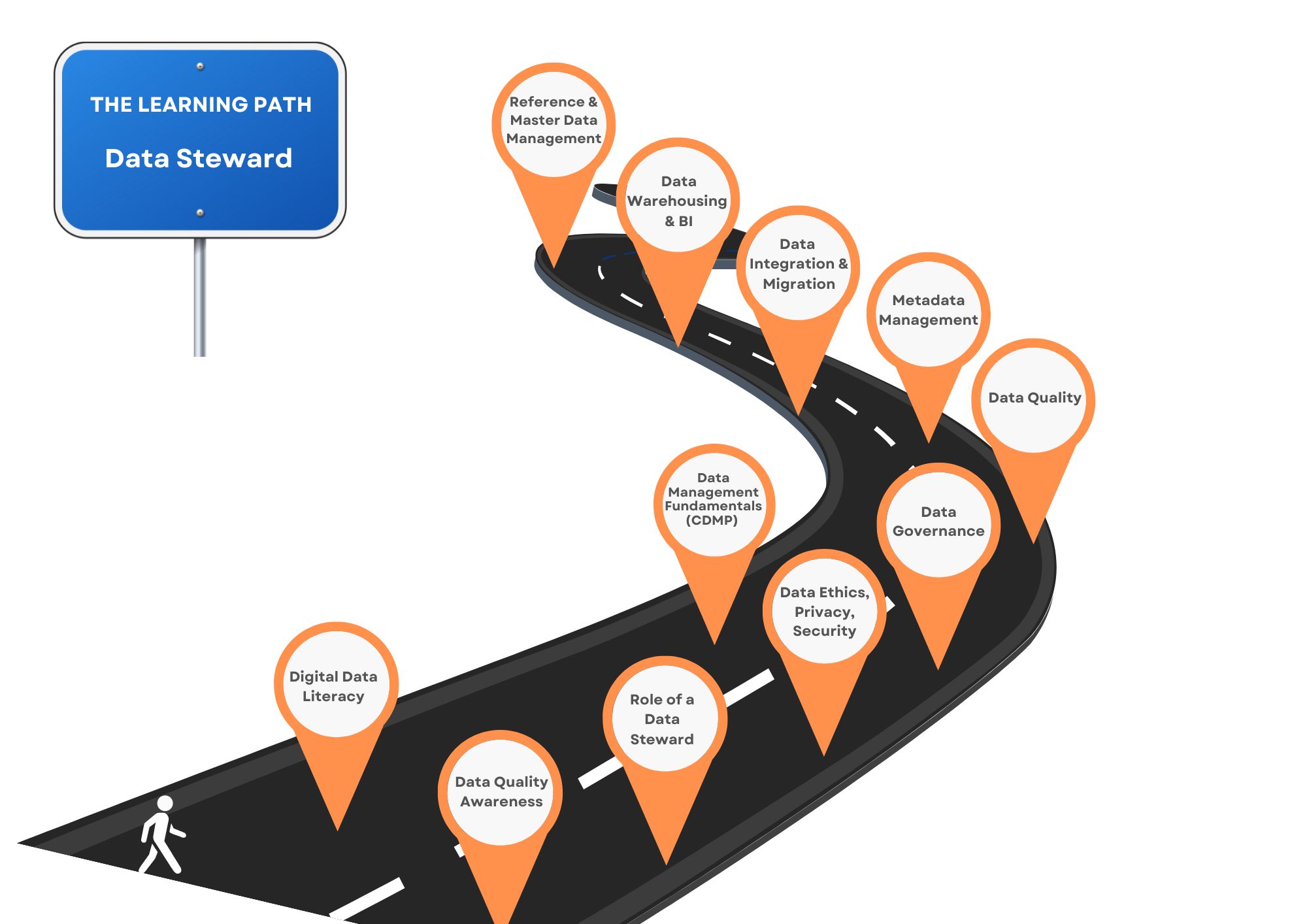
In today’s data-driven world, organisations increasingly depend on the quality, accessibility, and reliability of their data to make sound business decisions. Behind every successful data initiative stands a committed Data Steward — a professional who ensures that data is properly managed, trusted, and used responsibly. While many individuals now carry the title, not all fully grasp the breadth of their responsibilities or unlock the full potential of their role.
Those who do embrace it make an undeniable impact. Exceptional Data Stewards don’t just maintain data assets; they elevate data to a strategic organisational resource. They enable better decision-making, ensure compliance with data governance principles, and champion a culture of data quality across the enterprise.
A well-defined Learning Path is essential for developing the competencies and mindset required to excel in this role. Structured learning ensures that Data Stewards build their skills in a logical sequence, progressing from foundational knowledge to advanced, specialised expertise. The following path outlines key stages to help you grow from capable to exceptional.
1. Begin with Foundational Data Literacy and Data Quality Awareness
Before mastering the technical aspects of data management, it’s vital to understand the language of data. Data Literacy is the ability to read, interpret, and communicate data meaningfully. It equips you to engage confidently with stakeholders, from executives to analysts, and to advocate for data-driven thinking across the organisation.
Equally important is awareness of Data Quality — understanding the principles of accuracy, completeness, consistency, timeliness, and validity. Poor-quality data erodes trust, leads to flawed decisions, and wastes valuable resources. A Data Steward with a strong grounding in Data Quality can not only identify and correct issues but can also educate others about the importance of maintaining high-quality data at every stage of the data lifecycle.
Start your learning journey by exploring introductory courses, such as data literacy and foundation. This will provide you with the conceptual grounding to help you explain to others why data matters.with the conceptual grounding to help you explain to others why data matters.
2. Enrol in a Comprehensive Data Steward Training Course
Once you have a solid foundation, the next step is formal training specifically designed for Data Stewards. A comprehensive Data Stewardship course will help you understand how your role fits into the broader Data Management ecosystem.
Look for training that covers:
Roles and Responsibilities: What you are accountable for as a Data Steward, and how your work intersects with roles like Data Owners, Data Governance, and other Data Professionals
Practical Tools and Techniques: Methods for cataloguing data assets, defining metadata standards, managing data issues, and improving data quality etc.
Business Alignment: How to ensure that your stewardship activities support business goals, compliance requirements, and ethical data usage.
An effective course will blend conceptual learning with real-world application, such as case studies, hands-on exercises, and exposure to Data Management tools. This experience helps you translate knowledge into day-to-day effectiveness and will position you to fill the critical role of Data Steward for your organisation.
3. Build Core Competencies across Data Management Disciplines
To be effective, Data Stewards need to master several core competencies. These include:
Data Governance: Understanding the policies, standards, and control processes that ensure data is properly managed and aligned with organisational objectives
Metadata Management: Knowing how to define, capture, and use metadata — the “data about data” that provides context, meaning, and traceability
Data Quality Management: Establishing and maintaining processes for profiling, monitoring, and improving data quality across systems
Privacy and Data Ethics: Ensuring compliance with data protection laws (such as POPIA or GDPR) and promoting ethical use of data.
Building competency in these areas transforms you from a data caretaker into a data advocate — someone who understands both the technical and human sides of managing data responsibly.
4. Focus on Specialist Areas aligned to your Organisation’s Priorities
As your confidence grows, consider your daily activities and business objectives and identify where further training will add the most value. Take time to study frameworks like the DAMA-DMBOK (Data Management Body of Knowledge), which provides a comprehensive view of all data disciplines.
Reflect on the following:
Are you involved in a Data Migration or Integration project where data accuracy and consistency are critical?
Do you contribute to Business Intelligence or Analytics initiatives where data availability and interpretation drive insights?
Is your organisation implementing a Master Data Management (MDM) system?
Each of these areas demands specialised Data Management knowledge. Exceptional Data Stewards continuously align their learning with their organisation’s goals and data initiatives.
Seek out opportunities to gain hands-on experience, such as participating in data governance committees, conducting data quality assessments, or contributing to metadata documentation. The more you engage with real data challenges, the deeper your expertise becomes.
Remember, the most effective Data Stewards are not confined to a single area — they are versatile contributors who understand how data flows through the organisation and how each system or process impacts overall data integrity.
5. Consider Professional Certification through the DAMA CDMP Program
Once you’ve established your specialist skills, consider pursuing formal recognition through the DAMA Certified Data Management Professional (CDMP) program. The CDMP certification, recognised globally, validates your knowledge across the full range of Data Management disciplines defined by DAMA International.
The Data Management Fundamentals exam is an excellent starting point and can be taken at any stage of your learning journey. Achieving CDMP certification in both fundamentals and specialist disciplines will demonstrate your commitment to professional excellence and your knowledge of data management best practices, enhancing your credibility within your organisation and across the broader data community.
6. Cultivate Continuous Learning and Collaboration
The data landscape evolves rapidly — with new technologies, regulations, and practices emerging constantly. Exceptional Data Stewards stay relevant by engaging in continuous learning.
Join professional communities, attend webinars or conferences, and follow thought leaders in the field. Participate in internal data governance forums to exchange insights with colleagues. Deep your understanding, build confidence, and connect to a global network of peers and mentors.
Collaboration is another hallmark of success. Data Stewardship doesn’t operate in isolation; it thrives on partnership with IT, business units, and compliance teams. By building relationships and fostering open communication, you can help bridge gaps between technical experts and business decision-makers, ensuring everyone is aligned around shared data goals.
7. Embody the Mindset of a Data Champion
Ultimately, becoming an exceptional Data Steward is not just about mastering processes — it’s about adopting a leadership mindset.
Exceptional stewards view data as an asset to be nurtured, protected, and leveraged. They are change agents who champion data culture and help others see the value of working with trusted, well-managed data. They lead by example, demonstrating integrity, and accountability for the data quality.
Strive to go beyond compliance. Encourage innovation, support data literacy initiatives within your organisation, and promote how data can create value for customers, employees, and the whole business.
Conclusion
The journey to becoming an outstanding Data Steward is one of continuous growth and meaningful impact. By following a structured learning path — from foundational literacy to advanced certification — you not only strengthen your own career but also contribute significantly to your organisation’s success.
Your organisation’s data, and indeed its future, depend on people like you: individuals who take stewardship seriously, who see data not just as information but as a strategic asset, and who are committed to upholding its quality, integrity, and ethical use.
Good luck on your journey to becoming an exceptional Data Steward!
Have you ever wondered why your data initiatives keep falling short?What's missing? It's often not what you think.
You have invested in the latest technology, you've hired smart people, written the policies, yet somehow, your data quality is still questionable, reports don't match, and people are still making decisions based on gut feeling rather than facts.
The missing piece is collaboration. Technology and processes alone will not deliver results. Success requires investing in people, relationships, communication, and collaboration that will unite business leadership with technical expertise.
Not just any collaboration - the specific partnership between your Data Owners and Data Stewards. These two roles form the foundation, and true collaboration creates a partnership, forming the triangle.
What is a Data Owner?
A Data Owner is someone who has the authority and accountability for data within a specific business domain in the organisation. They are usually senior business leaders - department heads, product managers, executives. They’re the decision-makers who understand the business i.e. A Marketing Manager owns Customer Data, a Finance Manager owns Finance Data, an Operations Head owns Supply Chain Data.
Data Owners possess the business insights to understand how the data should be used, and what outcomes it should drive. They control the budgets and make strategic decisions about the data; they are the ones who can say "yes" or "no" to data initiatives.
What is a Data Steward?
Data Stewards are the operational guardians of quality and compliance; they are the caretakers of the data. Whilst they may not set strategic direction, these practitioners possess the critical technical knowledge about data structures, the processes, and systems. They implement the day-to-day management required.
They work closely with the data, ensuring it meets the defined standards and required level of quality, and they resolve issues. They know which systems talk to each other and understand the data flows, and they can spot anomalies. Data Stewards are your eyes and ears on the ground.
They're the ones who clean the data, monitor it, and fix it when things go wrong. They live and breathe data every day, and need to be equipped with the right skills and knowledge to perform their role effectively.
Why do these roles need each other?
Here's the thing - neither can succeed alone.
Data Owners without Data Stewards is like having Executives without staff: lots of strategy and vision, and policies that look great on paper, but are not achieved.
Data Stewards without Data Owners. That's like having staff without direction. They're working hard, fixing problems, managing quality, but their efforts don’t achieve the desired results.
These roles naturally complement each other. Data Owners provide the "why" and Data Stewards deliver the "how". You need both, you need the authority and the capability.
What happens when they don't work together well?
In many organisations, these groups operate in isolation or in parallel, which prevents the achievement of the required results.
Data Stewards and Owners work in isolation, they build frameworks that get ignored, they implement solutions that work technically but don't get traction. Data Stewards fix the same problems over and over again. They get frustrated, they can see the underlying issues but don't have the authority to fix the root causes.
You can feel as if you are “spaghetti up a hill*.” Lots of effort but little progress and Data Debt accumulates.
* Lisel Engelbrecht - Chief Information Officer for Data, Analytics, and AI at Standard Bank South Africa.
The power of collaboration
What happens when Data Owners and Data Stewards work together effectively? When these two groups work together, and achieve true results, real things start to happen. You see, collaboration is the third critical element required for these roles to achieve the desired outcomes.
When Data Owners & Data Stewards collaborate effectively, data can truly be an asset.
Organisations that successfully implement this collaborative approach see results across the board:
Improved Data Quality
Enhanced Analytics
Decision-Making speeds-up
Increased User buy-in
Reduced Risk and Compliance issues
Better Resource allocation
Better data leads to more usage, more usage leads to more analytics and improved analytics leads to better business outcomes. Organisations can do more, because you can trust the data.
How do they work together effectively?
The collaboration begins with shared understanding.
Data Owners must appreciate the technical complexities and requirements that Data Stewards navigate daily. Conversely, Data Stewards need insight into the business priorities and the constraints that drive the Data Owner’s decisions. Mutual respect forms the foundation for productive partnership.
Consider shared metrics, both Data Owners and Data Stewards should be measured on the same results. When they succeed together or fail together, they're motivated to collaborate.
Accountability alone isn't enough though. People need to develop the skills to collaborate effectively. Many Data Owners battle to communicate data requirements clearly. Many Data Stewards struggle to translate technical issues into business language.
Create regular communication forums that builds these collaborative skills over time. Not just status meetings - real conversations where both groups learn from each other.
Establish clear escalation paths. When Data Stewards spot issues that could impact business, they need a direct line to Data Owners.
When Data Owners need to implement new requirements, they need to work with Data Stewards to make it happen.
Recognize and reward collaboration. Build these collaborative capabilities across your teams, then celebrate the success from this group working together.
Your data is only as strong as the people managing it
Are your Data Stewards and Data Owners working together or in parallel?
The most sophisticated technology in the world can’t do it alone, if your Data Owners and Data Stewards aren't working well together. The Data Triangle of Collaboration isn't just a nice-to-have, it's a business imperative. In an environment where data drives competitive advantage, organisations cannot afford to ignore this.
Think about your current situation. Do your Data Owners and Data Stewards have regular, meaningful conversations? Do they share common goals? Are they solving problems together, or working in parallel? Have you invested in developing the skills and knowledge needed to make this partnership work in practice?
The Data Triangle has three points: Data Owners at one corner, Data Stewards at another, and collaboration connecting them. Overlook any one of these, and your data efforts will struggle to make progress.
The Path Forward - what are you going to do about it?
In today's business landscape, data isn't just an asset—it's the foundation upon which competitive advantage is built. Yet, many organisations struggle to extract real value from their data investments.
Start simple. Bring your Data Owners and Data Stewards together for an honest conversation about current challenges and shared goals. You might be surprised how much common ground you find. Don't stop there - help them develop the skills they need to sustain this collaboration, and build the capabilities they need to succeed? Like any valuable skill, effective data collaboration can be learned and improved.
The organisations that successfully blend strategic vision with operational excellence, will find themselves with a sustainable competitive advantage built on reliable, accessible, high-quality data. Those that don't will continue wondering why their data investments aren't paying off.
Food for thought
What efforts are you making to strengthen the collaboration between your Data Owners and Data Stewards? Are you building bridges, or are you building silos? The choice is yours.
Empower the guardians of your data galaxy. After all, quality data is stewarded by people who care about getting it right.
Before we explore the importance of data stewardship, let’s take a step back and consider the term 'Steward'. A steward is someone who looks after something on behalf of another. A steward cares for that which is entrusted to them.
So, a Data Steward is someone responsible for the care of the Data in the organisation—they are the caretakers of the Data Assets.
Everyone in the organisation should strive to produce quality data. However, the Data Stewards bear the responsibility for ensuring that this occurs and for addressing the situation when it does not.
Why is the role so important?
Data Stewards play a crucial role in the hands-on management and governance of data within the organisation. They act as custodians to ensure that the data is accurate, consistent, accessible, and secure throughout its lifecycle.
Data Stewards serve as the eyes and ears, the feet on the ground, and the heartbeat of a data-driven organisation.
Where to find Data Stewards
The organisation is filled with potential Data Stewards. All you need to do is identify them, nurture them, inspire them, and, most importantly, educate them.
Data Stewards are found in all areas of the organisation, including Business and IT. They are usually chosen because they are Subject Matter Experts (SMEs) and have expert knowledge of their Data Domain. Then, they need to be enabled to perform the role to the best of their ability.
What do Data Stewards do?
Data Stewards must implement mechanisms to ensure adherence to standards and processes. They play a role in defining Governance Controls to ensure compliance with ethical and regulatory requirements.
They define the quality expectations of the data – the rules, targets, and thresholds – and they monitor and report on improvements to data quality. Data stewards must manage what occurs in the event of data issues, posing questions such as: How should we handle this? How should we escalate this? How should we resolve this? How can we prevent this from recurring?
Here is a breakdown of what Data Stewards typically do:
Data Quality Management
Monitor and improve data accuracy, completeness, consistency, and timeliness.
Identify and resolve data quality issues (e.g., duplicates, missing values).
Data Governance Implementation
Enforce data standards, policies, and business rules defined by the data governance team.
Ensure compliance with regulatory requirements (e.g., GDPR, POPIA, HIPAA).
Metadata Management
Maintain data dictionaries and business glossaries.
Document data lineage (where data comes from, how it’s transformed, and where it goes).
Data Lifecycle Oversight
Track data from creation to archival or deletion.
Ensure proper data retention and disposal practices.
Projects and Data Initiatives
Participate on projects and working groups to provide insights into the Data and ensure all aspects considered, e.g. Data Lineage, Data Issues, Data Governance requirements etc.
Data Privacy and Security
Understand Data Privacy requirements
Ensure Privacy and security are applied in all environments e.g. Operational, Archive, Disaster recovery, Data Warehouse
Oversee implementation and testing of Data Breach response
Collaboration with Stakeholders
Act as a bridge between business units, data owners, IT teams, and data governance bodies.
Translate business needs into data requirements and vice versa.
Issue Escalation and Resolution
Identify data-related risks and escalate unresolved issues to governance committees.
In the past, things were simpler. All you had were the operational Data Environments. Times have changed; now there are Data Warehouses, Big Data, Data Lakes, Data Lakehouses, and Data Meshes. You also have Reference and Master Data Management hubs, Data Integration and Data Migration, along with new architecture requirements.
The Data Steward must contend with numerous demands related to data and respond to questions they may not have even considered. They are managing more data than we ever imagined. Furthermore, they now face the challenge of how to care for the data that AI and digital transformation require.
The role of the Data Steward is evolving to encompass collaboration, enabling, and facilitation as some traditional tasks are managed by AI.
Of course, Data Stewards can also use AI to assist them with some of their tasks!
What Data Stewards need to know?
Here are just some of the skills required by Data Stewards:
Strong understanding of business processes and how data supports them;
Knowledge of Data Privacy laws and compliance standards (e.g. PoPIA, GDPR);
Attention to detail and problem-solving ability;
Excellent communication and documentation skills;
Understanding of Data Quality requirements;
Familiarity with data management tools (e.g., Collibra, Informatica, Alation).
With data underpinning everything the organisation needs to do, the role of the Data Stewards is more crucial than ever before. What efforts are being made to identify and support the Data Stewards in your organisation, and to equip them to address any challenges that future innovations may present?